
Joint Venture Opportunities in HYBRID Housing: Building High-Yield Assets Together


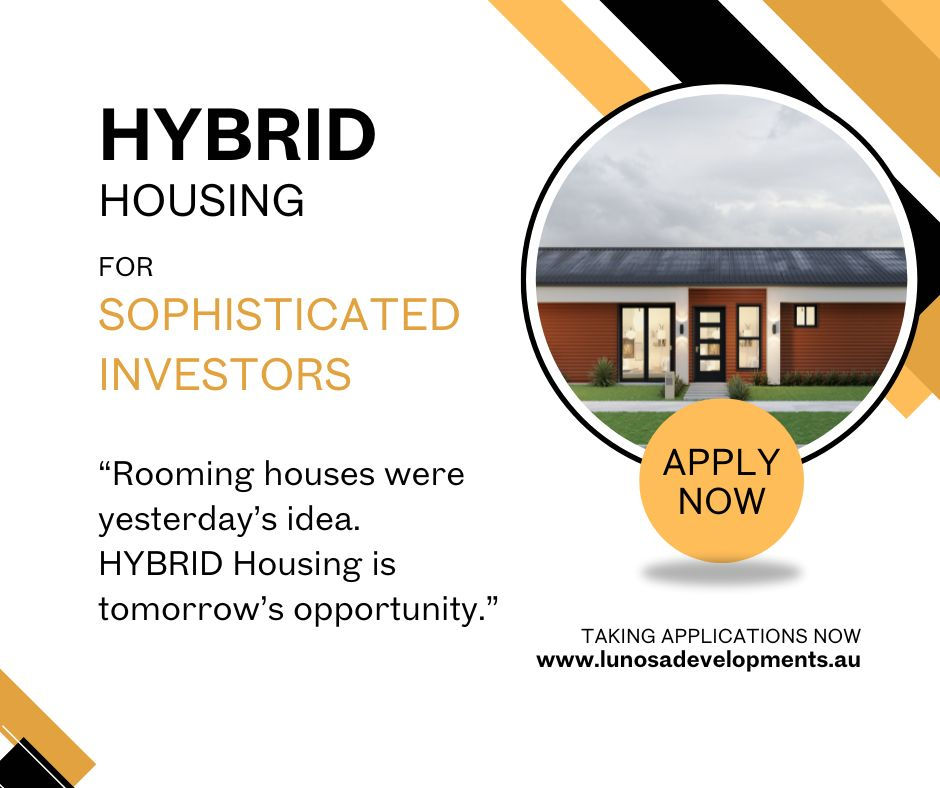
As residential property markets mature and margins tighten, sophisticated investors and landowners are increasingly turning to joint venture (JV) structures to unlock higher-performing outcomes. In this environment, HYBRID Housing has emerged as one of the most compelling JV opportunities in the residential sector.
By combining the income efficiency of rooming houses with the design intelligence of modern co-living—without falling under rooming accommodation legislation—HYBRID Housing creates a powerful platform for collaboration between capital partners, landowners, and delivery specialists.
This is not speculative development. It is strategic, performance-driven partnership.
Why Joint Ventures Are Gaining Momentum
Joint ventures allow investors to move beyond passive ownership and participate in value creation. Instead of competing for low-yield completed stock, JV partners collaborate to deliver assets purpose-built for today’s market realities.
HYBRID Housing is particularly well suited to this structure because it offers:
Strong feasibility fundamentals
Clear compliance positioning
Scalable, repeatable design
Multiple exit strategies
For landowners, it unlocks site value well beyond traditional single-dwelling or small multi-residential outcomes. For capital partners, it provides exposure to high-yield residential assets without bearing sole development risk.
HYBRID Housing: A JV-Ready Asset Class
Not all property models work well in joint ventures. Many carry planning risk, construction complexity, or regulatory uncertainty that can strain partnerships.
HYBRID Housing avoids these pitfalls.
It is a hybrid model—blending rooming-house income logic with co-living design principles—while remaining outside rooming accommodation classification. This distinction is fundamental to its JV appeal.
From day one, partners benefit from:
Reduced regulatory burden
No rooming accommodation infrastructure charges
Class 1a construction pathways
Predictable design and build outcomes
This clarity allows JV agreements to focus on value creation, not risk containment.
Class 1a Construction: Improving JV Feasibility
Construction classification plays a critical role in JV feasibility.
HYBRID Housing is delivered as a Class 1a build, not Class 1b. This has a direct impact on:
Construction cost
Approval complexity
Program certainty
Financing appetite
Class 1a construction aligns more closely with standard residential builds, making it:
Easier to document
Faster to construct
More familiar to lenders and certifiers
For JV partners, this reduces execution risk and improves return certainty—two of the most important drivers in successful partnerships.
Removing Rooming Accommodation Charges from the Equation
One of the most overlooked benefits of HYBRID Housing in a JV context is what it avoids.
Traditional rooming accommodation often attracts:
Additional infrastructure charges
Ongoing compliance costs
Increased scrutiny and operational oversight
These costs directly erode feasibility and complicate profit-share calculations.
Because HYBRID Housing does not fall under rooming accommodation legislation, JV partners benefit from a cleaner cost structure, clearer financial modelling, and stronger net outcomes.
This makes profit alignment simpler and disputes less likely—an essential factor in long-term partnerships.
Designed for Yield, Not Just Density
HYBRID Housing is not about cramming more rooms onto a site. It is about optimising yield through intelligent design.
Key characteristics include:
Predominantly private living spaces
Minimal shared areas (often only a laundry)
Efficient layouts that maximise rentable area
Strong acoustic and privacy performance
This design approach delivers:
Higher achievable rents per space
Lower vacancy risk
Reduced management complexit
For JV partners, this translates into stronger, more reliable cash flow, which underpins both holding and exit strategies.
Low-Maintenance Materials Protect Long-Term Returns
In joint ventures, long-term operating costs matter as much as upfront feasibility.
HYBRID Housing is deliberately constructed using eco-friendly, hard-wearing materials selected to reduce lifecycle costs and protect investor returns.
These include:
Composite cladding systems
Durable internal wall linings
Low-maintenance external finishes
The benefits for JV partners are clear:
Lower ongoing maintenance expenditure
Reduced capital works over time
Improved asset durability
Better ESG and sustainability outcomes
Over a typical holding period, these material choices materially improve net yield and asset performance.
Multiple JV Entry Points
HYBRID Housing allows for flexible JV participation structures, including:
Landowner + Capital Partner
Landowners contribute the site while capital partners fund construction and delivery, sharing in the upside created through higher-yield outcomes.
Capital + Development Expertise
Investors partner with an experienced delivery team to deploy capital into repeatable HYBRID Housing projects.
Portfolio-Style Partnerships
JV partners collaborate across multiple sites, standardising design and delivery to achieve scale and efficiency.
This flexibility makes HYBRID Housing attractive to a wide range of sophisticated investors, from private capital to family offices.
Strong Exit Optionality
A well-structured JV must always consider the exit.
HYBRID Housing offers multiple exit pathways:
Retain as a high-yield income asset
Sell to yield-focused investors
Aggregate into portfolio sales
Because the asset is not classified as rooming accommodation, it appeals to a broader buyer pool—supporting liquidity and valuation at exit.
This exit flexibility is a key reason JV partners are favouring hybrid housing over traditional rooming models.
Aligning with Market and Policy Direction
Councils and planning authorities are under increasing pressure to support housing supply without compromising neighbourhood character.
HYBRID Housing aligns with this direction by:
Delivering gentle density
Improving design outcomes
Supporting affordability
Avoiding legacy rooming house stigma
For JV partners, this alignment reduces political and planning risk while supporting long-term acceptance of the asset class.
A Partnership Model Built for the Next Cycle
Every property cycle rewards models that combine efficiency, resilience, and scalability.
HYBRID Housing delivers all three.
For joint venture partners, it offers a rare combination of:
High yield potential
Reduced regulatory burden
Class 1a construction advantages
Low-maintenance, durable assets
Strong tenant demand
This makes HYBRID Housing one of the most compelling JV opportunities in modern residential development.
For those seeking to collaborate on performance-driven, future-ready housing, hybrid housing is not just an opportunity—it is a strategic advantage.

Comments