
Why Sophisticated Investors Are Pivoting to HYBRID Housing Developments

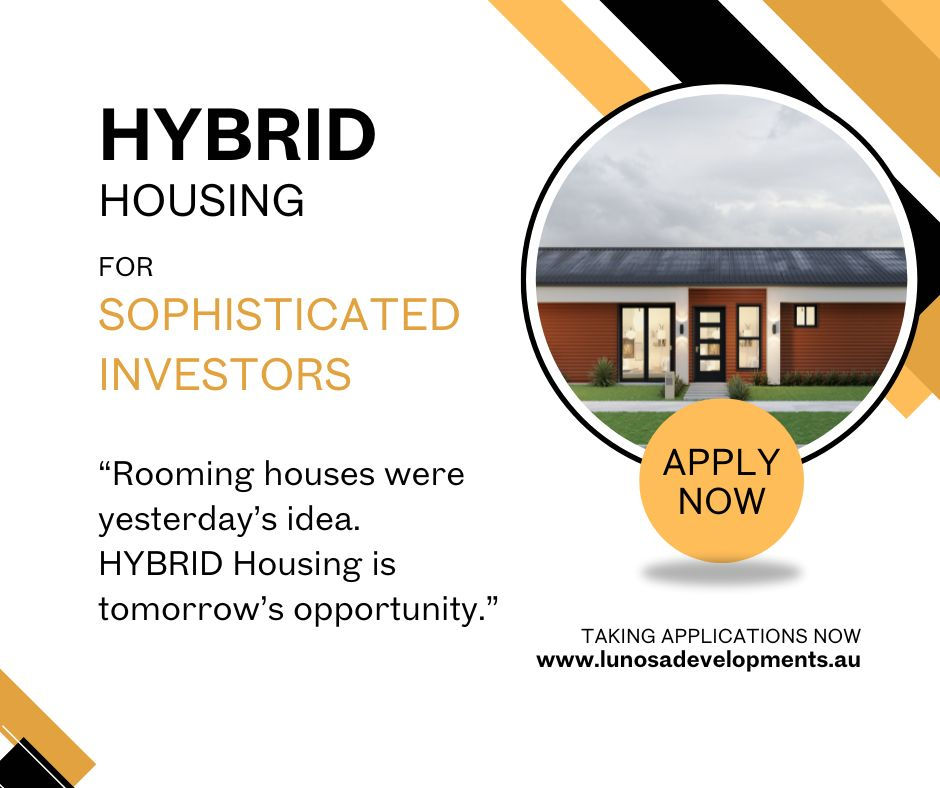
In an increasingly complex property market, sophisticated investors are no longer chasing growth alone. Yield certainty, regulatory efficiency, construction classification, and long-term operating costs now play a central role in capital allocation decisions.
This shift is driving a clear pivot toward HYBRID Housing—a new generation of residential development that combines the income efficiency of rooming houses with the design intelligence of modern co-living, without falling under rooming accommodation legislation.
For investors and joint venture partners focused on performance, HYBRID Housing represents a structural advantage, not a speculative trend.
A Hybrid Model Built for Investors, Not Headlines
HYBRID Housing is often misunderstood as either rooming accommodation or traditional co-living. In reality, it sits deliberately between both—retaining the strongest elements of each while removing their limitations.
From rooming houses, it takes income density and yield efficiency
From co-living, it adopts modern design, privacy, and tenant appeal
From a regulatory standpoint, it avoids rooming accommodation classification altogether
This distinction is critical.
HYBRID Housing does not fall under rooming accommodation legislation, does not attract rooming accommodation infrastructure charges from local councils, and is delivered as a Class 1a build, not Class 1b.
For sophisticated investors, these differences materially impact feasibility, risk, and long-term returns.
Class 1a Construction: A Strategic Advantage
One of the most compelling reasons investors are pivoting to HYBRID Housing is its Class 1a construction classification.
From a construction and compliance perspective, this delivers:
Lower build complexity compared to Class 1b
Greater design flexibility
Reduced construction and certification costs
Clearer approval pathways
Class 1a builds align more closely with traditional residential construction, making them faster to deliver and easier to finance—without sacrificing yield potential.
For joint venture partners, this classification improves feasibility margins and reduces execution risk.
Avoiding Rooming Accommodation Charges and Constraints
Traditional rooming accommodation often attracts additional infrastructure charges, compliance layers, and operational oversight. These costs compound over time and directly erode net returns.
HYBRID Housing avoids these burdens entirely.
Because it does not sit within rooming accommodation legislation, investors benefit from:
No rooming accommodation infrastructure charges
Reduced regulatory exposure
Greater certainty across councils and planning environments
Stronger exit appeal to future buyers
This regulatory efficiency is a key reason capital is flowing away from legacy rooming models and toward hybrid developments.
Designed for Yield, Engineered for Longevity
Sophisticated investors understand that net yield matters more than gross yield.
HYBRID Housing developments are designed not only to maximise income, but to minimise long-term operating and maintenance costs—a critical factor in sustained performance.
This is achieved through deliberate material selection and construction methodology.
Eco-Friendly, Low-Maintenance Materials
HYBRID Housing utilises durable, eco-friendly materials such as:
Composite cladding systems
Hard-wearing internal wall linings
Robust finishes designed for high-occupancy environments
These materials are selected to:
Reduce ongoing maintenance and repair costs
Improve durability and lifecycle performance
Lower vacancy disruption due to repairs
Enhance sustainability outcomes
Over a 10–20 year holding period, these choices materially improve net returns.
Minimal Shared Space, Maximum Efficiency
Unlike traditional co-living or rooming houses, HYBRID Housing deliberately limits shared spaces.
In many cases, the only shared area is a laundry.
This design philosophy delivers several investor benefits:
Reduced cleaning and maintenance costs
Lower wear and tear
Fewer tenant disputes
Greater tenant privacy and retention
From an operational standpoint, this creates a cleaner, simpler asset that behaves more like a residential investment—while delivering commercial-style yield.
Strong Demand Without Lifestyle Dependency
Traditional co-living often relies on lifestyle branding and communal experience to attract tenants. This can be fragile in changing markets.
HYBRID Housing demand is driven by fundamentals:
Affordability
Privacy
Location
Quality of build
Tenants are not paying for shared lounges or social programming—they are paying for private, affordable, well-designed accommodation.
This makes HYBRID Housing more resilient across market cycles.
Portfolio-Grade Scalability
Sophisticated investors think in portfolios, not one-off projects.
HYBRID Housing is inherently scalable because:
Designs can be standardised
Construction is repeatable
Compliance pathways are consistent
Management is simplified
This makes hybrid housing well suited to:
Multi-site investment strategies
Joint venture pipelines
Long-term capital deployment
It also improves exit optionality, appealing to future investors seeking stabilised, high-yield residential assets.
Why Joint Venture Partners Are Leaning In
For landowners and capital partners, HYBRID Housing unlocks value that traditional residential strategies often leave on the table.
Joint venture benefits include:
Higher yield outcomes from the same site
Shared development risk
Access to specialised design and build expertise
Clear alignment between parties
Because HYBRID Housing sits outside rooming accommodation legislation, it is often easier to structure, finance, and deliver within JV frameworks.
The Institutional Shift Toward Smarter Housing
What we are seeing is not a short-term pivot—it’s a structural shift.
As housing affordability challenges intensify and councils seek smarter density solutions, HYBRID Housing aligns with both market demand and policy direction—without inheriting the stigma or constraints of traditional rooming accommodation.
This is why sophisticated investors are moving early.
They recognise that HYBRID Housing sits ahead of regulation, not behind it, and delivers a combination of yield, durability, and compliance efficiency that traditional models cannot match.
HYBRID Housing: Built for the Next Cycle
In every property cycle, capital flows toward models that offer efficiency, certainty, and performance.
HYBRID Housing delivers all three.
By blending the best elements of rooming houses and co-living—while avoiding their drawbacks—hybrid housing has emerged as a preferred strategy for investors and JV partners who think long-term.
This is not yesterday’s rooming house. This is tomorrow’s residential investment model—engineered for sophisticated investors.


Comments