
Hybrid Housing Explained: Why the Next Generation of Co-Living Is Outperforming Traditional Investments


The residential property market is evolving rapidly. Rising construction costs, affordability pressures, shifting tenant demographics, and tighter lending conditions are forcing investors to rethink traditional investment models.
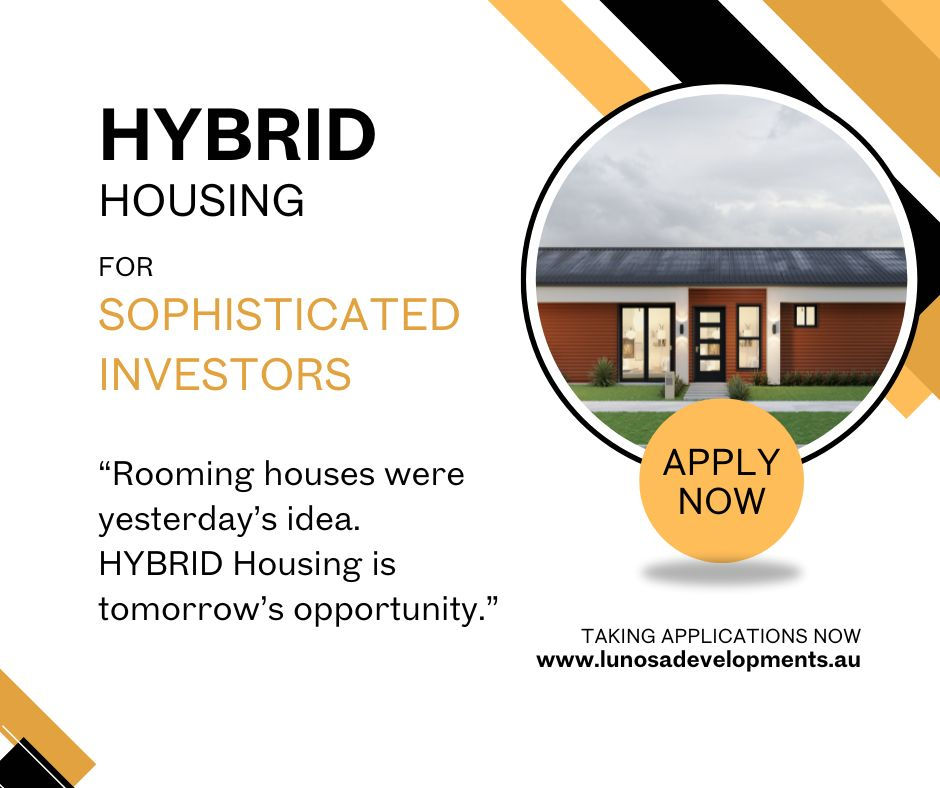
In this changing landscape, HYBRID Housing has emerged as a clear standout—representing the next generation of co-living, evolved from the proven foundations of rooming accommodation, and engineered for superior yield and long-term performance.
For sophisticated investors and joint venture partners, hybrid housing is not a trend—it is a strategic response to market demand, planning realities, and the need for resilient cash flow.
What Is HYBRID Housing?
HYBRID Housing is an advanced form of co-living, built on the established rooming accommodation model but significantly enhanced through smarter design, improved livability, and increased operational flexibility.
Where traditional rooming accommodation focused on maximising room count, hybrid housing takes a more refined, future-ready approach. It blends:
Private, well-designed living spaces
Shared amenities
Flexible layouts that appeal to broader tenant demographics
Strong compliance with modern planning and building standards
The result is co-living, supercharged—a model that delivers higher yields while improving tenant retention, asset quality, and long-term scalability.
The Evolution from Rooming Accommodation to Hybrid Housing
Rooming accommodation has long been recognised as one of the highest-yielding residential asset classes. However, older models often faced challenges around perception, tenant experience, and design limitations.
HYBRID Housing evolves this model by addressing those weaknesses head-on.
Instead of outdated layouts and minimal amenity, hybrid housing developments are purpose-built to meet modern expectations. They prioritise privacy, durability, acoustic performance, and shared spaces that enhance daily living—without sacrificing the financial advantages that make rooming accommodation so attractive to investors.
This evolution allows investors to retain the strong income fundamentals of rooming accommodation while future-proofing assets against regulatory changes, tenant expectations, and market competition.
Why Co-Living Demand Is Accelerating
The growth of co-living is being driven by fundamental demographic and economic shifts:
Rising rental costs across metropolitan and growth corridors
Increased demand for flexible, affordable housing
More single-person households and mobile workers
Lifestyle-driven renters prioritising location and amenities
HYBRID Housing meets this demand directly. By offering affordable, high-quality living environments, hybrid housing developments attract consistent tenant demand across students, key workers, professionals, and downsizers.
For investors, this translates to lower vacancy rates, stable cash flow, and diversified income streams within a single asset.
HYBRID Housing vs Traditional Residential Investments
Compared to standard houses, townhouses, or apartments, HYBRID Housing offers several compelling advantages:
1. Higher Yield Per Site
Hybrid housing maximises income per block by optimising density and rental configuration—often generating significantly higher gross yields than traditional dwellings.
2. Stronger Cash Flow Resilience
Multiple income streams reduce reliance on a single tenant, creating built-in risk mitigation and more stable returns.
3. Better Use of Land
With land prices continuing to rise, hybrid housing allows investors to extract more value from each site without compromising compliance.
4. Future-Proof Design
Purpose-built co-living assets are better positioned to adapt to changing tenant needs and regulatory frameworks.
This performance-driven design is why more sophisticated investors are shifting capital away from low-yield assets and into hybrid housing developments.
Planning, Compliance, and Risk Management
One of the key advantages of HYBRID Housing is its alignment with established planning frameworks related to general residential building.
Rather than relying on speculative rezoning or aggressive assumptions, hybrid housing builds on recognised use definitions while improving design outcomes. This reduces planning risk and provides greater certainty during approvals and delivery.
From a construction perspective, purpose-built hybrid housing also enables:
Standardised detailing and materials
Lower maintenance costs over time
Improved durability in high-occupancy environments
For investors and JV partners, this means fewer surprises, better lifecycle performance, and stronger long-term asset value.
Why Investors Are Targeting HYBRID Housing Now
Timing matters in property investment, and hybrid housing sits at the intersection of multiple favourable forces:
Persistent housing undersupply
Increasing affordability pressure
Growing acceptance of co-living as a mainstream solution
Investor demand for yield-driven assets
As traditional residential yields compress, HYBRID Housing offers a scalable alternative that aligns with both market demand and institutional-style investment thinking.
This is why hybrid housing is increasingly viewed not just as a niche strategy, but as a core component of forward-looking property portfolios.
Joint Venture Opportunities in Hybrid Housing
HYBRID Housing is particularly well suited to joint venture structures, where capital, land, and expertise are combined to deliver high-performing developments.
JV partners benefit from:
Access to specialised design and construction expertise
Shared risk and aligned incentives
Exposure to high-yield assets without sole development responsibility
For landowners, hybrid housing can unlock significantly greater value than traditional subdivision or single-dwelling strategies.
For capital partners, it offers entry into a resilient asset class with strong downside protection and scalable upside.
The Future of Co-Living Is Hybrid
Co-living is no longer an emerging concept—it is an established response to how people live, work, and move today. HYBRID Housing represents the most advanced form of this evolution, combining the financial strength of rooming accommodation with modern expectations of comfort, privacy, and design.
As housing challenges intensify and investor priorities shift toward performance and resilience, hybrid housing is positioned to outperform traditional residential investments well into the future.
For those looking to stay ahead of the curve, HYBRID Housing isn’t just an option—it’s the next logical step in high-yield residential investing.


Comments